Exploring Capacity Gaps for Improved Disaster Risk Reduction within UNESCO-Designated Heritage Sites in Africa
Author: Dr. Emmanuel Eze
First supervisor: Prof. Dr. Alexander Siegmund
Second supervisor: Prof. Dr. Olaf Bubenzer
Summary:
Disasters resulting from natural and human-induced hazards increasingly threaten natural and cultural heritage worldwide, and UNESCO-designated heritage sites in Africa are among the most vulnerable. These sites hold significant cultural, economic and educational value, yet their preparedness for disaster risks and the capacity of the actors responsible for managing them remain insufficiently understood. This cumulative dissertation investigates the exposure of UNESCO-designated heritage sites in Africa to disaster risk hotspots and evaluates the capacity of site managers and associated actors to address these risks, with the aim of establishing a foundation for education and capacity-building initiatives aligned with the Sendai Framework for Disaster Risk Reduction.
Grounded in Protection Motivation Theory and the Person-Relative-to-Event model, the study used a cross-sectional mixed-methods design. It combined surveys and interviews with site actors, a content analysis of national policy documents, and spatiotemporal analyses of decade-long Index for Risk Management (INFORM) data for 53 African countries (Eze & Siegmund 2024a, 2024b). Approximately 41% of Africa's UNESCO-designated heritage sites are located in national disaster risk hotspots, with key hazards including floods, wildfires and violent conflicts, exacerbated by systemic issues such as poverty and displacement. Human-induced hazards and the concentration of vulnerable groups proved to be far stronger determinants of national disaster risk than natural hazards, while violent conflict remains under-addressed in key policy frameworks (Eze & Siegmund 2024b).
While some site actors demonstrate sufficient competence in next-generation core competencies for disaster risk management, the study reveals significant gaps in access to and use of innovative technologies such as GIS, unmanned aerial vehicles and disaster insurance, alongside limited financial and technical resources (Eze & Siegmund 2024c, 2024d, 2024e; Eze, Petersen & Siegmund 2024). The findings call for integrated formal and non-formal educational initiatives in heritage conservation and disaster management, combining scientific expertise with the local knowledge of stakeholders and host communities to build resilience and secure the sustainability of Africa's heritage for future generations.
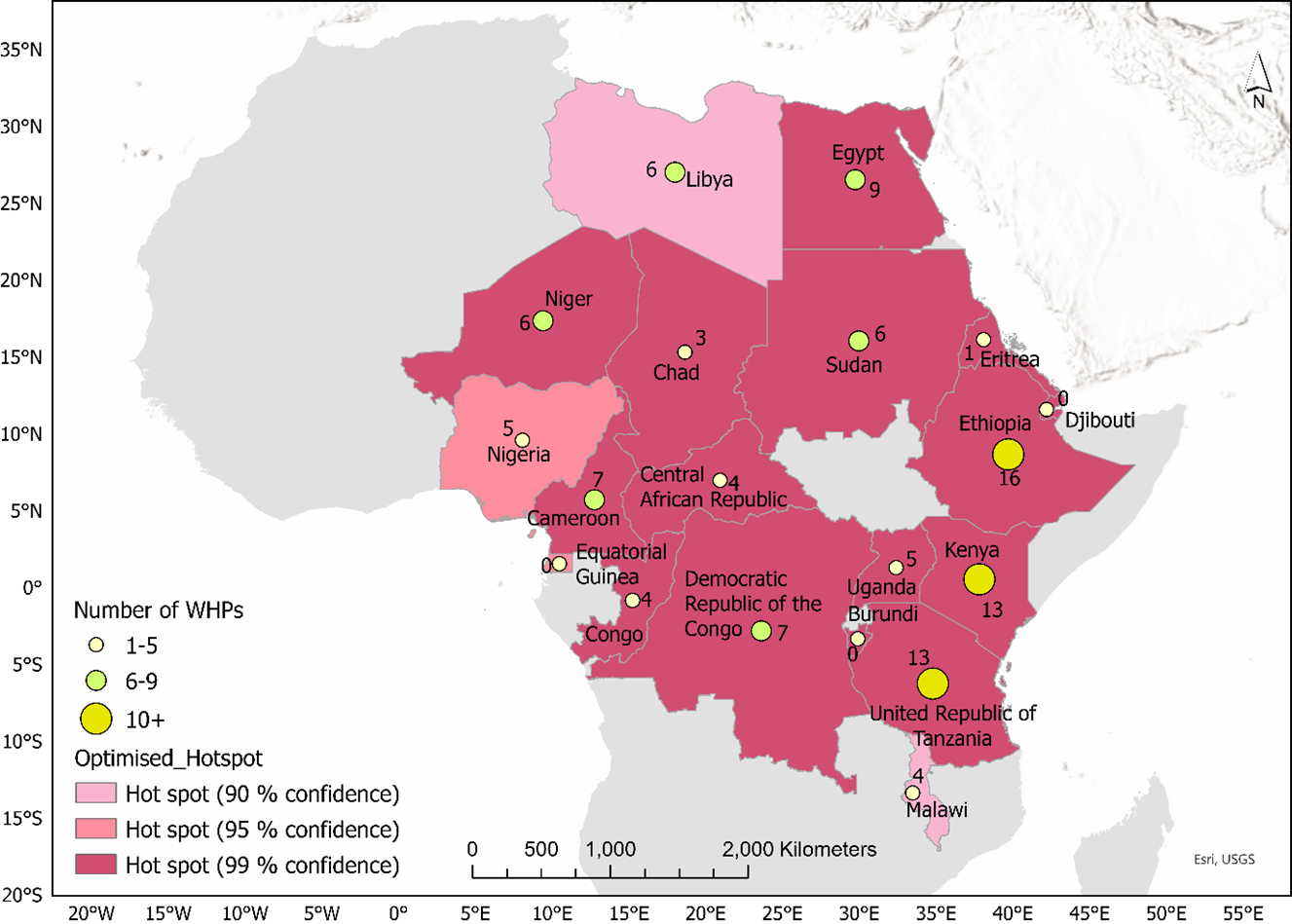
African World Heritage properties in national disaster risk hotspot countries. Proportional circles indicate the number of World Heritage properties located in each hotspot country.
References
Eze, E. & Siegmund, A. (2024a): Identifying disaster risk factors and hotspots in Africa from spatiotemporal decadal analyses using INFORM data for risk reduction and sustainable development. Sustainable Development, 32 (4), 4020–4041. https://doi.org/10.1002/sd.2886
Eze, E. & Siegmund, A. (2024b): Analyzing important disaster risk factors for enhanced policy responses in perceived at-most-risk African countries. Environments, 11 (2), 27. https://doi.org/10.3390/environments11020027
Eze, E. & Siegmund, A. (2024c): Next-generation core competency gaps for disaster risk management and preparedness in UNESCO-designated heritage sites. Sustainable Futures, 8, 100239. https://doi.org/10.1016/j.sftr.2024.100239
Eze, E. & Siegmund, A. (2024d): Appraising competency gaps among UNESCO-designated heritage site actors in disaster risk reduction innovations. Progress in Disaster Science, 22, 100321. https://doi.org/10.1016/j.pdisas.2024.100321
Eze, E. & Siegmund, A. (2024e): Exploring factors of disaster preparedness in UNESCO-designated heritage sites. Geography and Sustainability, 5 (3), 392–404. https://doi.org/10.1016/j.geosus.2024.04.001
Eze, E., Petersen, M. & Siegmund, A. (2024): Enhancing protection motivation for disaster preparedness among actors at UNESCO-designated heritage sites in Africa. International Journal of Disaster Risk Reduction, 109, 104599. https://doi.org/10.1016/j.ijdrr.2024.104599
Eze, E. (2025): Assessing disaster risk exposure and capacity gaps for resilience and sustainability within UNESCO-designated heritage sites in Africa. Environmental Education Research, 31 (8), 1751–1752. https://doi.org/10.1080/13504622.2025.2472970


