KI:EO – Innovative Ways of Earth Observation for Schools
Using Artificial Intelligence to Promote Earth Observation Data in the Classroom
Julian Stolz, M. Sc., Dipl.-Geogr. Christian Plass, Dr. Nils Schorndorf, Prof. Dr. Alexander Siegmund
Earth observation (EO) data is a central tool for systemically analyzing and evaluating global challenges such as climate change, natural hazards, urbanization, or resource utilization. Despite its high potential, the use of satellite, drone, and time-series data in schools continues to face significant technical, didactic, and methodological hurdles. In particular, complex analysis procedures, individual learning requirements, and a lack of time resources make effective integration into the classroom difficult.

The KI:EO project addresses these challenges by linking Earth observation, didactics, and Artificial Intelligence. The goal is to develop AI-based assistance and authoring systems that adaptively support students while working with EO data and relieve teachers in the creation, adaptation, and quality assurance of digital learning modules. The foundation is the proven media network consisting of the adaptive e-learning platform geo:spektiv and the web-based Earth observation tool BLIF, which has been continuously expanded and tested in previous projects.
At the heart of KI:EO are two interconnected AI components:
- An AI-based Learning Assistant: This accompanies students directly within the learning modules and during the analysis of Earth observation data. It provides content-related, methodological, and procedural feedback, adapts assistance to the student's learning level, and supports various competence levels without giving away solutions. This specifically promotes self-regulated learning, systems thinking, and a reflective approach to AI.
- An AI-powered Wizard for Teachers: This supports the development, revision, and adaptation of e-learning modules. Existing content can be updated, simplified, or translated; new modules can be created in a structured manner along defined learning objectives, quality criteria, and didactic principles. This significantly simplifies the use of Earth observation in the classroom and ensures its quality.
All developments are accompanied by empirical research, evaluated, and iteratively optimized. The learning modules created during the project, focusing on current environmental and spatial issues, contribute to the sustainable anchoring of Earth observation and Artificial Intelligence within school education.
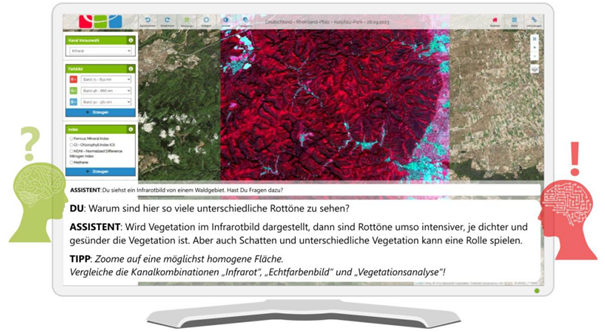
Fig. 1) Simulation of a chatbot in the web-based Earth observation tool "BLIF".
Project Duration: January 1, 2026 – December 31, 2028
The project is funded by the German Space Agency at DLR with funds from the Federal Ministry for Economic Affairs and Climate Action.